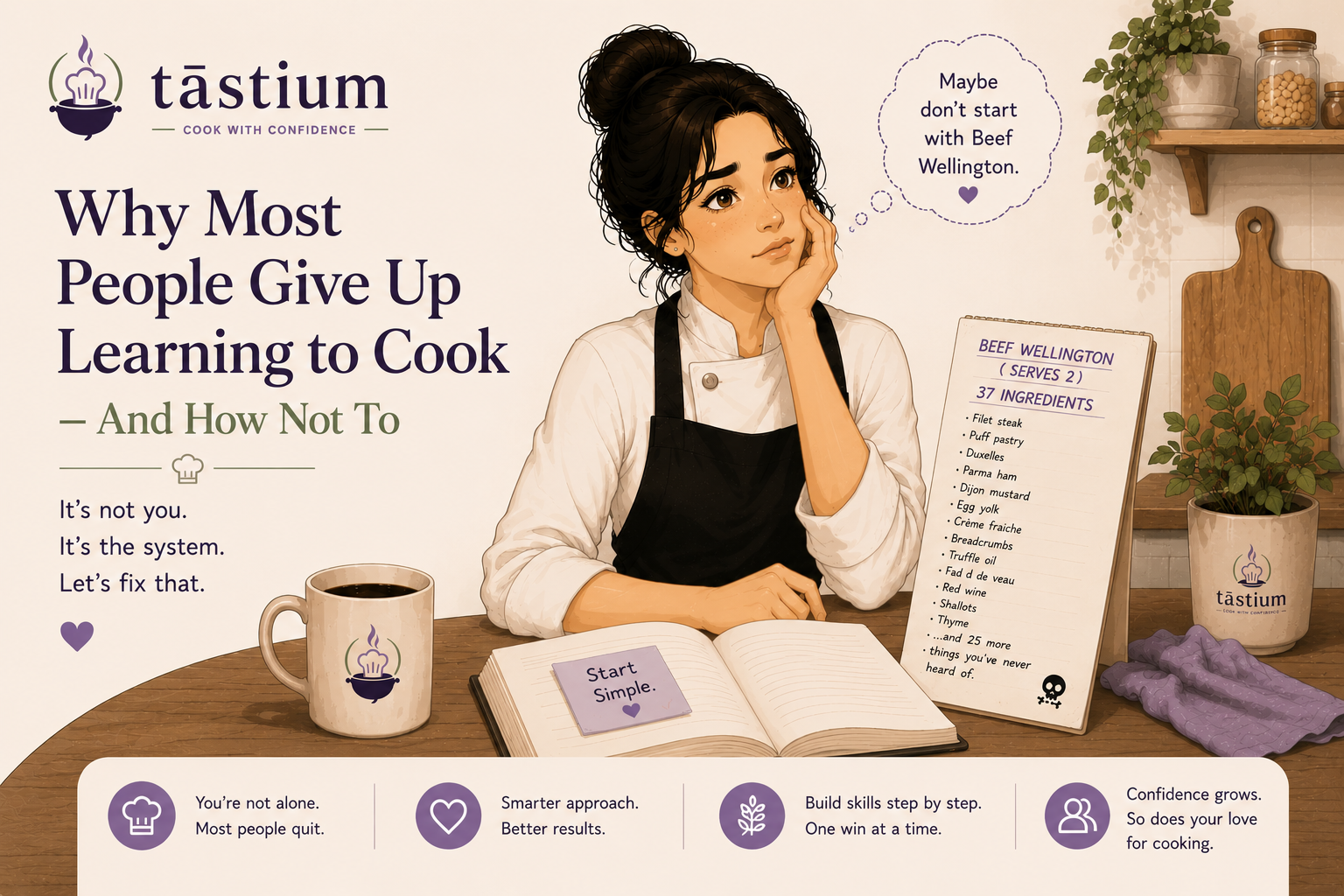
People usually give up learning to cook because they start with recipes that are too difficult, do not understand cooking language, receive no feedback, make one or two mistakes and decide they are simply “bad at cooking”. The solution is to lower the difficulty, repeat simple meals and focus on progress rather than perfection.
If you’ve tried before and stalled, you’re not unusual - and it isn’t a talent problem. It’s almost always one of these five causes. (For the full beginner path, start with how to learn to cook.)
Reason 1: They start too ambitiously
A beginner who starts with a complicated dinner-party recipe is more likely to feel overwhelmed. Success comes from choosing meals that teach one or two skills at a time. A simple tomato pasta teaches boiling, sauce-making and seasoning. That is enough for an early win.
Reason 2: Recipes assume too much
Recipes often use language that beginners do not fully understand. “Brown the meat”, “fold gently”, “reduce the sauce” and “season to taste” are meaningful only if someone has seen and practised those steps before.
Reason 3: There is no feedback
When a dish goes wrong, a beginner may not know why. Was the heat too high? Was the pan overcrowded? Did the food need more salt or more time? Without feedback, mistakes feel personal rather than practical.
Reason 4: Cooking happens at stressful times
Many people try to learn after work, when everyone is hungry and time is short. That is the hardest possible moment to practise. Learn during lower-pressure moments and rely on simple meals on busy nights.
Reason 5: They compare themselves to experts
Social media makes cooking look effortless. But experienced cooks have repeated basic techniques hundreds of times. Compare your latest meal to your previous meal, not to a professional chef.
People give up when cooking feels like a performance. They keep going when cooking feels like practice.
How not to give up
Use a small cooking habit: one new meal per week, one repeated meal per week and one easy fallback meal. Keep ingredients simple. Track progress. Ask what each meal taught you. This turns cooking into a skill-building process instead of a pass-or-fail test - the same mindset behind cooking with confidence.
In summary
Most people quit because the difficulty was set too high and a single bad result was treated as proof. Lower the difficulty, repeat the wins, and the habit sticks.
Frequently asked questions
Yes. Cooking involves many small skills, so it is normal to feel slow or unsure at the beginning. Repetition makes those skills easier.
Choose easy meals, repeat them, track improvements and cook for someone supportive when you are ready. Motivation grows when progress is visible.
The biggest mistake is starting too difficult and then treating one bad result as proof they cannot cook.